Our Mission Research
Profile Fabrication
Capabilities
Collaboration
Director
Info Contact
Info

Welcome
Welcome to the Home Page for the
State of Utah Center of Excellence for
Biomedical Microfluidics at the University of Utah.
The Center is dedicated to the discovery, understanding, development and
commercialization of
microscale and MEMS devices for application to biological, biomedical, and
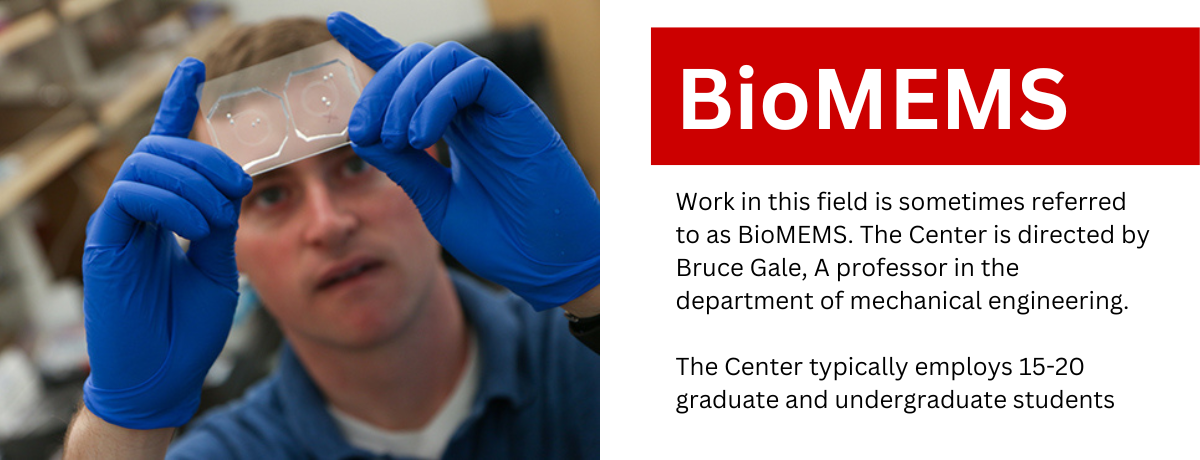
medical problems. Work in this field is sometimes referred to as BioMEMS.
The Center is directed by Bruce Gale, an
associate professor in the Department
of Mechanical Engineering. Typically about 15-20 graduate and
undergraduate students are employed in the Center.

To discover, understand, develop and commercialize microfluidic components and
systems directed towards improving human health while generating
knowledge, educating students, and creating economic development
opportunities. We regularly partner with leading industrial,
academic, and government institutions in developing microfluidic
solutions to challenging biomedical problems.

The Center is focused on the understanding of fluidic systems at the micro- and
nano- scale. The Center uses both microfabrication and
nanotechnology to discover and develop miniaturized microfluidic instruments
capable of measuring, actuating, or separating biomedical materials, molecules,
and components. The Center has projects in six related areas.
- Microscale particle separation systems based on field flow fractionation
- Continuous flow spotter
- Nanoscale chemical sensing systems based on optics
- Microscale particle detectors
- Microscale pumps
- Integrated microfluidic devices for diagnostics
- General microfluidics
The Center also has a strong interest in developing microfabrication and
nanotechnology techniques and has developed methods for creating single material
waveguides, assembling and fabricating
microfluidic components, depositing ultrathin sensing layers, and packaging
microfluidic systems.

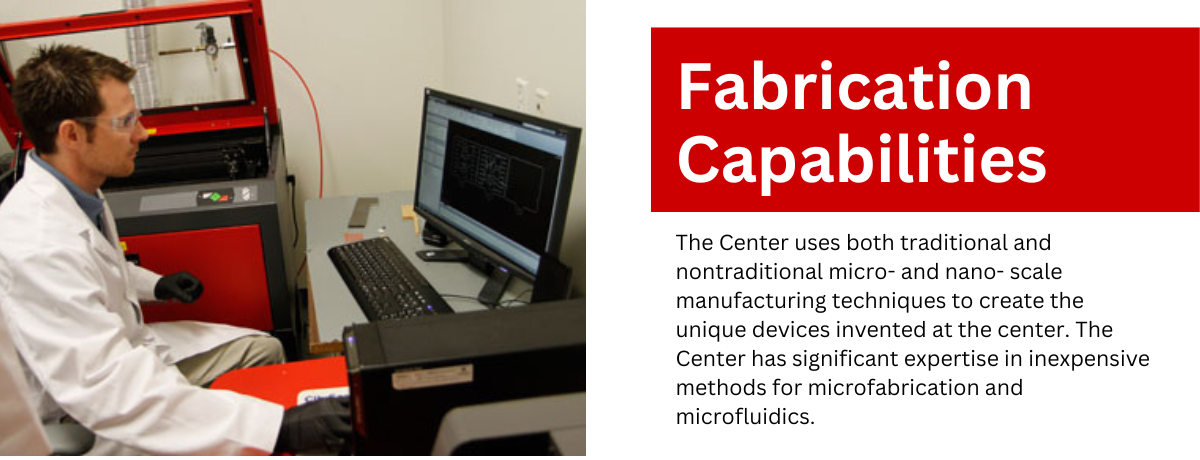
The Center uses both traditional and nontraditional micro- and nano- scale
manufacturing techniques to create the unique devices invented at the
center. The Center has significant expertise in inexpensive methods for
microfabrication and microfluidics. The classical MEMS and microfabrication capabilities are housed in the
University of Utah College of Engineering Microfabrication Labs.
These capabilities include: photolithography, bulk and surface
micromachining, sputtering, evaporation, PECVD, LPCVD, furnaces,
electroplating, MEMS packaging, and related techniques.
The less traditional microscale techniques employed by the center include: soft lithography,
polymer micromolding, xurography or knife cutting, thin film lamination, and mechanical techniques. For
example, we
have developed unique technologies for making monolithic PDMS waveguides and 3-D
microfluidic devices.
Accordingly, we can integrate optics and fluidics in a single manufacturing
step.
The Center also has expertise in nanoscale self assembly using
electrostatic layer by layer assembly of polymers, particles, and other
charged species. We use this technique to make nanoscale sensors for
oxygen, glucose, cholesterol, and other chemicals.
A summary of equipment in the Center is available here.

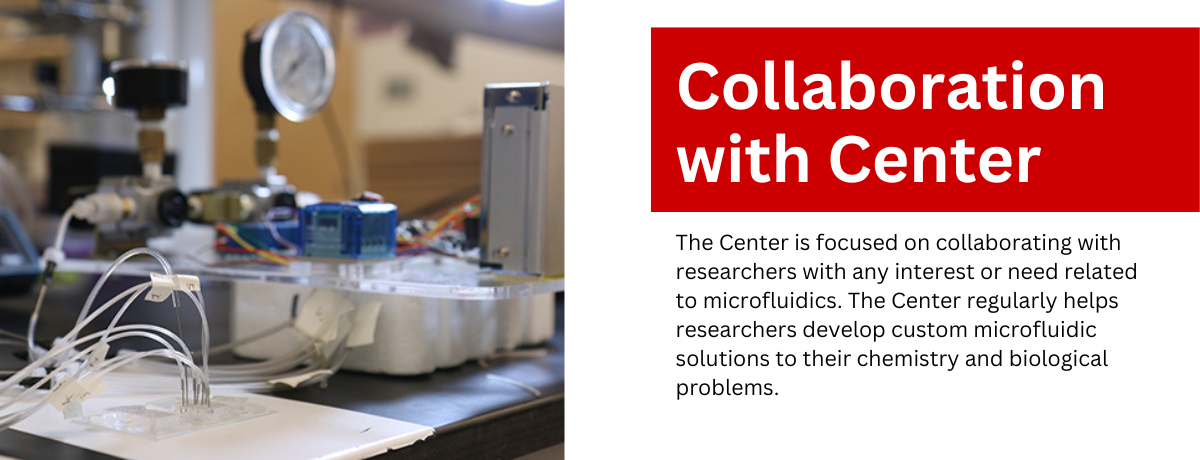
The Center is focused on collaborating with researchers in with any interest
or need related to microfluidics. The Center regularly helps researchers
develop custom microfluidic solutions to their chemistry and biological
problems. We have substantial experience in design, manufacturing, and
testing of a wide range of microfluidic devices. We can also provide
foundry services to those looking for just a manufacturing partner. We
look forward to working with you on your projects. If you have questions,
please
contact the director
Bruce Gale.

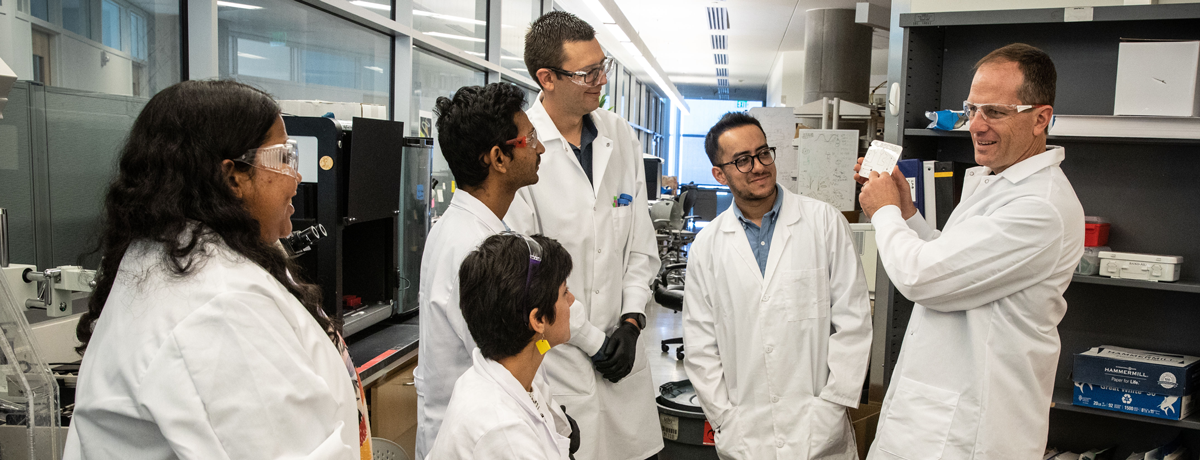
The Center director is Bruce
Gale, an associate professor of
Mechanical Engineering with adjunct appointments in Bioengineering,
Electrical Engineering, and Materials
Science. Dr. Gale has a decade worth of
experience in BioMEMS, MEMS, microfabrication, and engineering. Dr.
Gale also works with a start-up company that has been spun out of the center, Wasatch Microfluidics.
More
personal information about Dr. Gale can be found at his home
page. Dr. Gale is also organizing the
13th International Symposium on
Field- and Flow- based Separations (FFF 2007).